When people first see a layout robot printing wall lines on a slab, the reaction is always the same: why isn't every site doing this already? The honest answer is that most layout robots stop working the moment the floor stops being perfect. Dust kills print quality. Debris blocks small wheels. Vibration blurs lines. Sunlight washes out ink.
We started COROSOLS from the opposite end: assume the slab is rough, dusty, outdoors, and busy - then design a machine that holds millimetre-grade accuracy anyway.
Three engineering choices that matter
1. Independent suspension
A rigid chassis transfers every bump straight into the printing mechanism. Our robot rides on independent suspension that absorbs the small shocks of a real slab - surface laitance, aggregate, the odd pebble - so the marking head stays stable while the wheels deal with the terrain.
2. Mecanum wheels
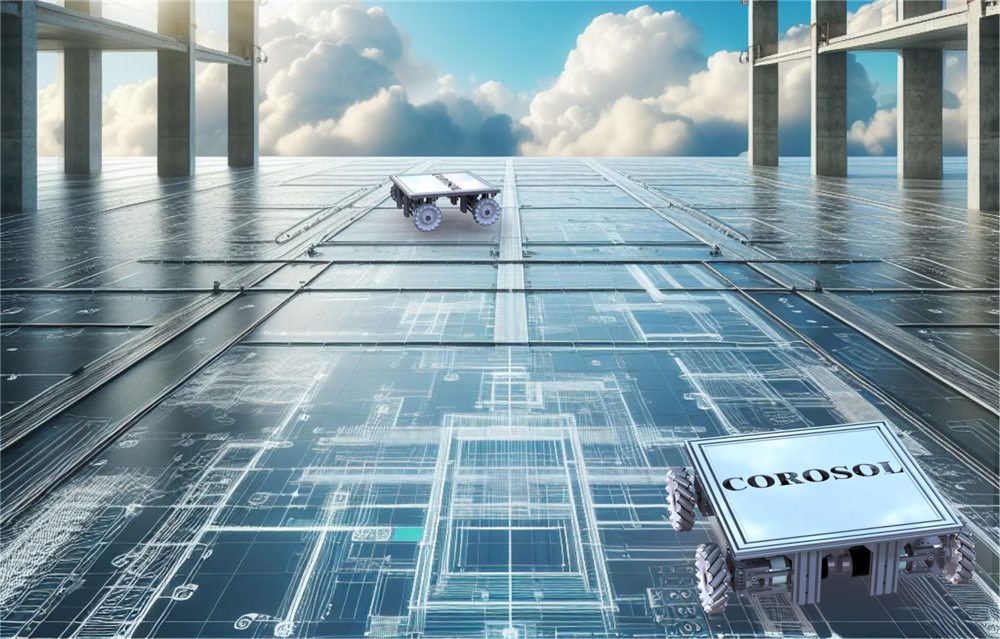
Layout work is full of tight moves: nudge 30 cm sideways, square up to an axis, trace around a column. Mecanum wheels let the robot translate in any direction without turning its body - no three-point turns, no lost alignment, and enough wheel surface to shrug off small debris that would strand a smaller drive system.
3. A spray head, not an inkjet
Here is the choice we consider our core IP: instead of the inkjet or laser approaches used by other layout systems, COROSOLS prints with a high-precision spray paint head - patent pending (national and international filings). Spray paint grips rough and porous concrete, survives site traffic, and works in full daylight, outdoors, on the surfaces contractors actually pour.
We didn't design a robot and hope sites would accommodate it. We took the site as the spec sheet. COROSOLS engineering principle
How the robot knows where it is
Precision doesn't come from the wheels - it comes from surveying. A robotic total station (RTS) tracks a 360° prism mounted on the robot's mast, continuously feeding survey-grade position data back to the controller. It's the same class of instrument used for structural stakeout, applied to every centimetre the robot prints. We develop this integration in technology alliance with Leica Geosystems.
Why it matters: hand tracing accumulates error - each measurement chains onto the last. RTS guidance resets that: every printed point is referenced to the site's own control network, so line one and line one-thousand carry the same accuracy.
From your model to robot motion
The robot consumes standard construction models. Our printing algorithm converts a Revit or AutoCAD model into robot instructions automatically - walls, axes, openings, MEP routings and custom marks - and the operator supervises the mission from a tablet. No re-drawing, no manual coordinate entry.
Power comes from two interchangeable 25 Ah battery packs, good for five hours of continuous work - and because they're swappable, the robot doesn't wait for chargers.
Proven beyond the lab
This isn't a rendering-stage concept. The robot is a fully functional MVP, demonstrated publicly - including at the Salon du Revêtement in Casablanca, where COROSOLS won 1st Prize for Most Innovative Enterprise (January 2026) and the demo reached over 635,000 organic views, with coverage on BBC News Arabic, MEDI1TV and SNRT. Our current roadmap takes the platform from field-proven prototype to industrialised service fleet, with pilot programs alongside Morocco's largest contractors.
Want the numbers side of the story? See what manual layout really costs, or walk through a tracing mission step by step.